

 Meredith Corp., the publisher of popular women’s interest titles like Better Homes and Gardens and Ladies’ Home Journal, is getting into the television game.
Over Labor Day weekend, Better Homes and Gardens debuted free, ad-supported programming compatible with connected devices from Samsung, LG, Sharp, Philips, Toshiba and Roku. Meredith worked with Net2TV’s Portico TV Service to develop two 30-minute programs with paid 30 and 60-second commercial breaks.
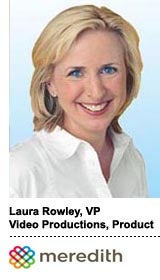
“We reach 60% of Millennial women through our platforms, which is more than MTV and Netflix,” remarked Laura Rowley, Meredith’s VP of video production and product, who joined Meredith last April from her role as head of original content and partnerships at The Huffington Post. The publisher reaches 100 million monthly visitors across digital and print.
“Right now, [connected TV] is a pretty nascent market, but I think this is where mobile was a year ago and we’ll see rapid growth throughout this year,” Rowley added. “It was important to us to get this show out the door and to be prepared for that uptick.”

Like Time Inc., which partnered recently with Portico TV service to turn short-form video content into streaming TV programs, Meredith also had a stockpile of short-form video dating back to 2012. These include 12,000 videos housed on its owned-and-operated sites.
The publisher considered “thousands” of data points before creating a single video, Rowley said, including search patterns, onsite traffic and most-pinned Pinterest items and shared slideshows. Meredith works with Krux Digital as its data-management platform to turn first-party audience insights into new media assets.
“Those analytics tell the story of what our audience perceives as important and that creates the springboard for our video creation, which will ultimately be rolled into our connected TV programming,” Rowley said. “It’s nice to base creative on what women really want and have authority come from the brands that have this loyalty. It’s a great way to ensure the growth of your content and platform.”
Although the publisher operates an outfit dubbed Meredith Video Studios for branded video content on behalf of clients like Kraft and Barilla, it is a separate entity from Rowley’s video production team, which consists of a group of ex-TV execs who collaborate directly with editorial on original content production.
“We didn’t want this video team to just descend on Meredith and start producing video,” she said. “It had to be a collaborative effort with the editors, who know the audience.”
Additionally, the publisher needed a scalable strategy to ensure video content could be distributed across devices.
“We knew we couldn’t do this device by device,” Rowley said, drawing on her production days at CNN. “To create an app for every single connected device out there is expensive and you have to maintain it and update it all the time. We wanted to be able to test a multiplatform product immediately.”
This fall, Meredith plans to experiment with more long-form content and to extend beyond the “how-to” formula its onsite videos traditionally use. Among its other considerations is investment in viewability metrics; Meredith works with Nielsen and “other” partners.
To help agencies and advertisers measure the success of connected TV advertising programs (and to license owned-and-operated content out for syndication), independent viewability auditing is imperative, Rowley said. “This area is changing so fast, that you have to be flexible in adopting partners who measure the quality, effectiveness of your ads, but we feel it’s important to do as a premium brand,” she noted. “You want to make sure you have a real audience for your content at all times.”









