 “Data-Driven Thinking” is written by members of the media community and contains fresh ideas on the digital revolution in media.
Today’s column is written by Kim Brown, founder and CEO at Centrally Human.
Of all the jargon being tossed around digital conversations these days, the phrase “precision at scale” is becoming increasingly common. Everyone wants it, but it’s innately paradoxical. And there are significant challenges to overcome before we can move the needle and achieve something real.
In recent years, we’ve seen technological innovation lead to incredibly precise targeting. Massive adoption of digital devices and platforms has created enormous demand for consumer content at a time of greater competition for consumers’ attention. At the same time, companies have increased expectations for marketing dollars’ effectiveness.
These trends have created the expectation and need for precision at scale – incredibly precise, hypertargeted, zero-waste campaigns with massive reach.
But how can a campaign be precise and have scale? There isn’t a clear definition for what makes a campaign precise or scaled. As a result, the definition is set by whomever best sells and rationalizes the plan, not whether it’s actually precise with maximum scale.
There also isn’t any industry standard dictating which parts of digital marketing should incorporate precision at scale. Is it applied at the channel or partner level, or is it realized through digital audience targeting or tactical optimizations? The confusion is causing marketers to apply the phrase to all types of campaigns, relevant or not. I absolutely believe precision at scale is a realistic expectation, as long as it’s clearly defined and tailored to the specific marketer’s business.

I define precision at scale as a way to target core audiences across channels. Data and technology are combined to create audiences with the largest potential. Precision at scale focuses on how many individuals, not just impressions, are reached.
Precision at scale can be applied at every plan level. Just like programmatic is a buying style that is used from planning to channel activation, precision at scale is a framework that’s integral in every layer of a plan.
The use of precision at scale will vary depending on the brand and campaign goal. For example, a CPG brand launching a new product may leverage precision at scale through the contextual placement of ads across the US, with a concentration in areas with historically high brand consumption. An online clothing retailer may employ well-segmented CRM targeting along with lookalike modeling and branded editorial.
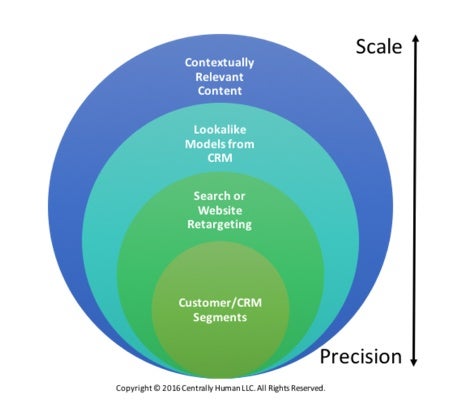
Marketers should create their own specific models to ensure the best fit for their business and marketing style-. I’ve included a data-driven precision-at-scale model to illustrate how a framework can allow for precise targeting and scale into larger, relevant audiences. This model starts with the most precise target first, with each excluded from the next targeting level. Custom precision-at-scale models can be applied across channels from reserve media to programmatic display, video, social, search for CRM and any other channels that allow advanced targeting, including addressable TV and digital audio.

We need precision at scale to best handle the growth in marketing budgets and the increased need for performance and spend accountability. To make it work, it’s critical to define precision at scale for individual businesses, employ a standard framework and empower teams to incorporate into all parts of the marketing process.
Precision at scale is a paradoxical reality that is here to stay. And it is an extraordinary opportunity to power the next generation of marketing with even more innovation and powerful business results.
Follow Centrally Human (@CentrallyHuman) and AdExchanger (@adexchanger) on Twitter.