

The cookie deprecation drama has turned into one of those cheesy slasher movies where the villain comically pops back up again and again from near-certain death. Marketers and advertisers are rightly tired of this limbo. But at this point it’s clear they don’t have to keep watching.
There are much better alternatives to the surface-level demographics and psychographics of cookie-based targeting. Advertisers can take control of their fate — and opt out of the cookie drama — by proactively moving toward new audience segmentation strategies around location intelligence. Because when it comes to understanding intent, it’s action that matters most.
Kicking the cookie habit
For far too long, the ad industry has subsisted largely on the demographic and psychographic data available through third-party cookies. This surface-level information inevitably produces a superficial understanding of consumer behavior. The result is the commonly high incidence of mislabeling: too many messages sent to the wrong person or at the wrong time.
A big part of the problem is that cookies fail to capture the complex nature of the consumer decision-making process. More specifically, segmentation and targeting based on interest overlooks the reality that action is the best predictor of true intent.

Actions matter: Using geolocation to predict intent
With all of us, there is a difference between what we say and what we do. To distinguish between superficial patterns or self-reported interests and consumers’ real-life behaviors, real-world mobility patterns provide perhaps the most direct and reliable insight into this differentiation. Location intelligence is grounded in the belief that the places individuals frequent reveal much about their preferences, lifestyles and purchasing behaviors.
Case in point: Location intelligence distinguishes between someone whose demographics suggest interest in seeing a newly released movie vs. the more probable intent of someone who recently or regularly visits movie theaters. It also separates a persona that casually browses sporting goods online from the more valuable persona that spends every weekend at the climbing gym. These are just a few examples of how geospatial data provides critical insight into consumers’ nuanced, real-world behaviors.
Making location intelligence privacy safe and GDPR compliant
This kind of location intelligence previously seemed incompatible with privacy-safe targeting. But the protracted cookie deprecation drama has given time for a new wave of innovation in geospatial targeting tools that crack the code on delivering location intelligence while prioritizing user privacy.
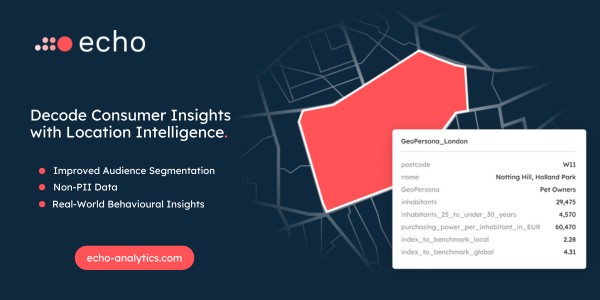
For example, we developed GeoPersona to give digital marketers a GDPR-compliant way to use geospatial data and location intelligence. With a tool like GeoPersona, marketers can harness fully anonymized geospatial data to understand mobility patterns and enable targeting that incorporates both interest and intent insights. Marketers can segment by brand affinity, lifestyle, preferences and household income.
Ultimately, this approach grounds targeting in the physical world, yielding much richer, more reliable targeting. The immediate result is better campaign performance. Marketers get higher engagement without increasing spending because they’re hitting all their high-value targets — and not wasting spend on mislabeled targets. Implemented well, location intelligence-based targeting drives the marketers’ ideal: low-budget, high-output ad strategies.
Quick fixes aren’t the answer – it’s time to break the habit
It’s hard to resist the easy path. That’s why cookie-based targeting dominated for so long, even as marketers gradually knew better. But as privacy measures tighten and traditional paths to consumer insights rapidly disappear, advertisers would be foolish to spend their limited time, energy and budgets chasing down new ways to get the same kinds of superficial insights.
Advertisers need to see Google’s most recent delay of cookie deprecation for the opportunity it is: giving them the time and space to finally go down a better path. One focused on deeply understanding consumers’ real-life behaviors, focusing on intent and building scalable location intelligence targeting strategies that improve campaign performance and maximize your ROI.
Make the smart choice.