Home Online Advertising Rocket Fuel IPO Explodes, Share Price Doubles In Early Trading

Rocket Fuel IPO Explodes, Share Price Doubles In Early Trading

SHARE:

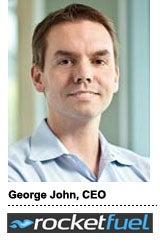
George John, CEO, Rocketfuel

Rocket Fuel is living up to its name in its first hours as a public company. After going public at $29, the high end of its range, the share price more than doubled to $62 by late morning. Since then it has fallen back to $55.50, as of noon EST, a 91% gain.

The running start suggests Rocket Fuel has done a good job telling its story and managing investor expectations. The ad network/demand-side platform raised $116 million, slightly more than the $102 million it originally hoped to raise at a share price between $24 to $27.

Some ad-tech industry observers  had thought that Rocket Fuel’s estimated valuation of nearly $1 billion was too high, given the gross margin pressure faced by large-scale ad network business models — even programmatic ones. Clearly many investors disagree.

There was one hiccup in Rocket Fuel’s public introduction on Friday morning, as the Nasdaq, where Rocket Fuel is trading as “FUEL,” halted trading briefly, though it was not clear why.

If investors’ early enthusiasm for Rocket Fuel holds, that could be a good sign for Criteo’s long-awaited entry into the public markets; it filed its F-1 earlier this week. Criteo, a retargeting specialist, (though it didn’t mention that discipline in its SEC filing) hopes to raise $190 million from the stock sale and is aiming for a valuation of around $2 billion.

As with recent ad-tech IPOs in the digital video space from Tremor and YuMe, Redwood City, Calif.-based Rocket Fuel is going public before reaching profitability. But whereas both Tremor and YuMe have shrunk their gap between loss and profit, Rocket Fuel’s loss has only grown. The company ended last year with a net loss of $10.3 million and ended the first six months of 2013 with a loss of $11.9 million.

Tagged in:

Must Read

TelevisaUnivision Joins The Streaming Self-Service Bandwagon

TelevisaUnivision is the latest TV publisher to join the self-serve trend that’s rising in popularity across connected TV advertising. Its streaming inventory is now available to buy through fullthrottle.ai’s self-serve platform. The collaboration includes an ad bidder designed to improve both targeting and measurement.

Comic: Gamechanger (Google lost the DOJ's search antitrust case)

For Google Advertisers Who Overpaid The Monopoly – Don’t Hate, Arbitrate

Law firm Keller Postman is leading mass arbitration suits against Google, seeking advertiser damages for alleged monopoly overpricing. The total available pot is a quarter-trillion dollars.

Can An AI Solution Fix Misaligned Marketing Orgs?

Opal launched Gem, a new AI solution, to help large brands unify the layers of media and tech within their organizations.

Privacy! Commerce! Connected TV! Read all about it. Subscribe to AdExchanger Newsletters

Sports Publisher On3 Tries AI Recommendations To Keep Engagement In Its Home Court

Mula’s AI native content feed helps On3 keep its engagement and RPS consistent amid traffic drop-offs to publisher sites and the growing scarcity of online attention.

Comic: Race To The Bottom

Hearst Built A Unified Ad Marketplace To Simplify Omnichannel News Buys

Hearst is stitching together its far‑flung news properties into a single programmatic marketplace to simplify buying local news and shore up its business as the ad market shifts.

Northbeam Adds The Third Leg Of The Attribution Stool With Incrementality Testing

There’s MMM and MTA, but no single ad measurement works for brands with multiple points of sale. On Tuesday, Northbeam launched an incrementality tool to complete what it calls “the trifecta of digital attribution.”