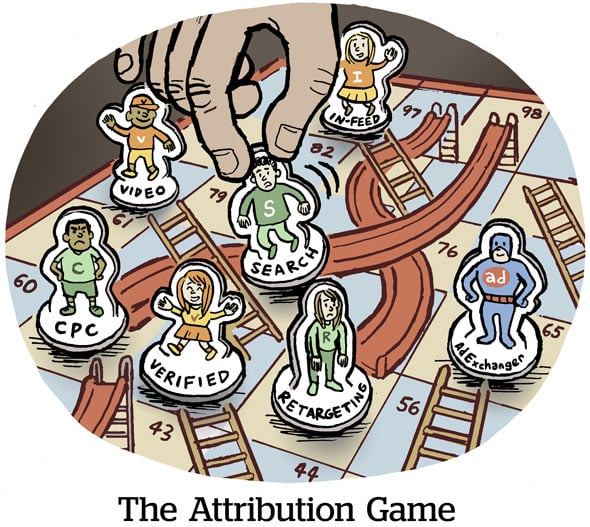
Advertisers don’t always trust the measurement they get directly from ad platforms.
Snap gets it.
Buyers need third-party measurement and a system with checks and balances to “assign credit where credit is due,” Fintan Gillespie, Snap’s global director of ad partnerships, told AdExchanger.
On Wednesday, Snap announced a new product called Unified Attribution that aligns Snap’s own data with that of mobile measurement partners (MMPs) to help app advertisers track measurement and optimize campaigns within Snapchat. The product is currently in beta and will launch later this year.
For now, Snap is only connected to AppsFlyer, but the longer-term goal is to integrate with “the entire ecosystem,” Gillespie said.
Giving credit
But to back it up, it makes sense why major ad platforms have done the grade-their-own-homework thing for so long.
Or, as Gillespie put it, platforms have been “optimizing to what they see, not what they get.” Which is to say, it’s been better for the bottom line to position their own internal measurement as the sole source of truth, rather than acknowledge the less glamorous reality that they’re just one factor in a larger conversion process.
Instead of forcing marketers to pick a side, Snap is trying to combine multiple views of performance to “better align Snapchat performance data and MMPs,” Fintan said.
When marketers set up their campaigns on Snapchat, they’ll be able to select “Unified Attribution” from a drop-down menu, which enables dual optimization based on both Snapchat’s attribution framework as well as the measurement provided by MMPs, said Shobha Diwakar, Snap’s VP of ads platform.
MMPs attribute credit using a “sort of waterfall system,” said Gillespie, by looking at a brand’s ad delivery and clicks across platforms to determine what factors ultimately led to a download.
He compared it to a game of basketball. It’s not just the person who makes the winning shot who should get credit for the team’s win, but everyone who passed the ball on the way down the court. A download is the result of a similar series of assists.
The role of MMPs, said Gillespie, is figuring out who passed the ball.
They track exactly when an app download occurred and then run an as real-time as possible check against every performance and delivery channel, including AppLovin and TikTok, to see exactly which ads were served and how they performed over time, he said.
Then the MMP determines how to allocate credit depending on performance.
Since rolling out Unified Attribution in beta earlier this year, Snap has begun optimizing campaigns based on both its internal first-party signals and signals from AppsFlyer.
Many advertisers already make budget and other business decisions based on MMP results, said Gillespie, and there has always been a “discrepancy” between Snap’s own results and those of MMPs. That discrepancy keeps getting bigger the more channels and networks an advertiser adds into the mix.
Snap now receives a real-time feed of its attribution credit from the MMP that it feeds into its internal machine learning models so advertisers can more accurately and efficiently optimize toward performance.
Understanding attribution on a larger scale has always been the “core goal” of MMPs, said Gillespie, which is why it’s important to listen to them.
“They do a bloody good job,” he said.