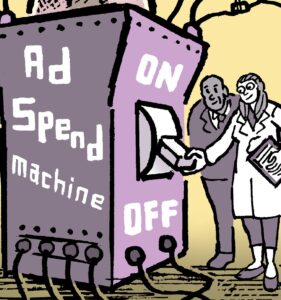

The web is hurting. Google is doing splendidly.
The second quarter was a “standout,” Alphabet CEO Sundar Pichai told investors on Tuesday, with “robust growth across the company.”
Pichai’s use of the word “the company” is notable, though.
Google’s total revenue grew by 14% to $96.4 billion in the quarter, and its net profit was up from $23.6 billion in Q2 of last year to $28.2 billion this quarter. That was helped along by double-digit growth in Google Cloud, YouTube and the core search business, each of which added many billions of dollars to its respective year-over-year total.
However, the Google Network – which is to say, revenue that goes to web publishers and app developers who plug into Google’s ad tech – ticked down, albeit slightly, by roughly $100 million.
Artificial intelligence, real money
Investors had a weather eye out for potential squalls from Alphabet this quarter.
“The company” had high growth forecasts – which, it should be noted, were surpassed – and there was also general concern in the market that the decline in traffic and earnings reported by web publishers might be a harbinger of a slowdown in Google’s revenue.
AI Overviews (AIOs) and AI mode, Google’s generative AI search products, are siphoning meaningful search market share, but have yet to generate significant revenue.
That concern can be effectively shelved for now – for Google shareholders, that is. Publishers are still getting smoked.
Chief Business Officer Philipp Schindler repeated a now mantra-like response to the question of making money, which is that Google sees “monetization at approximately the same rate” for an AIO search response as with a traditional search. This “gives us a strong base to innovate on the next generation of ad formats,” he said.
Still, investors have trouble buying that claim.
Who are the winners?
Multiple analysts asked for more details on whether AI-generated search responses were being monetized by “fewer, bigger winners,” presumably platforms like Reddit, Quora or Pinterest with data licensing deals with Google that inform its AI models.
But from Google’s perspective, the big winners in the AI revolution will be users.
Considering how early we are with generative AI search and agentic AI assistants, “it’s clear to me,” Pichai said, that these interfaces will eventually be the superior, preferred method for doing what are now standard Google searches.
Pichai also said that there may be losers, not just winners.
“Savvier players,” he said, will lean into the technology, i.e., enthusiastically adopt Google’s AI models. Just like with the early days of the web, he said, early movers will gain valuable ground. “So, it is an opportunity for some,” Pichai said.
On the other hand, he added, “obviously, there is the value proposition for all players involved.” By which he means that Google is still working out the details.
In traditional search, there is a well-understood dynamic of value and returns that have been honed over a decade, as one investor noted, including factors like ad relevancy and click-through rate.
And that value proposition has not been persuasively reproduced for two key stakeholders in the equation: publishers and advertisers.
“It’s not just a technology play,” Pichai said of Google’s AI-based search product. “But,” he acknowledged, “we have to solve the business models for the varying players involved.”