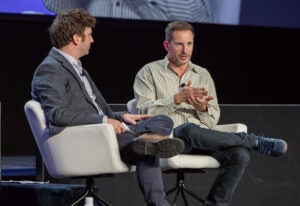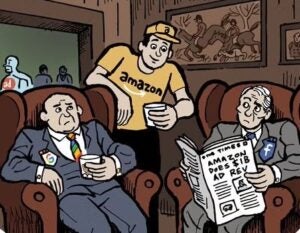

Arete Research’s Richard Kramer and Rocco Strauss didn’t pull any punches at AdExchanger’s Industry Preview event in New York City on Tuesday.
The investment analysts predicted a reckoning in the year ahead for companies that depend on digital ad revenue, which they expect to decline by 5% to as much as 10% in 2023, thanks to “demand destruction.”
Arete’s projection differs from ad agency projections, which predict a 3%-5% increase in ad spend for the coming year.

These more optimistic projections could be attributed to three factors, Strauss said.
First, a conflict of interest prevents agencies from encouraging marketers to spend less. Second, agencies lack transparency into ad spend from small and medium-sized enterprises (SME), which spend about 50%-70% of their ad budgets on Google’s and Meta’s platforms without any agency involvement. Third, increased costs from inflation were passed on to consumers in 2022, which meant brands had more to spend on ads; that same dynamic will not play out as inflation drops in the second half of 2023.
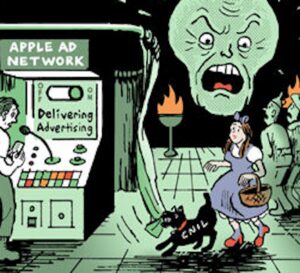
Demand destruction will be most apparent in the mobile app market thanks to Apple’s AppTrackingTransparency (ATT) policy, which opts iOS users out of having their device IDs tracked by default, Kramer said. Signal loss from ATT has already caused app install and direct response ad budgets to evaporate, which is bad news for app developers in the once-burgeoning quick-commerce, crypto-trading and casual-game markets.
And mobile signal loss will only get worse due to the upcoming Android 13 update, which is expected to crack down on the use of device IDs for targeting ads to Android users.
Market corrections
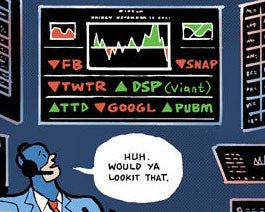
Among the 15 ad tech “unicorns” that went public in 2020 and 2021, all of them are currently below their IPO price. And the ad tech industry is only about halfway through the current bear market, which will persist for about another year, according to Arete Research.
“We’ve swung from uncapped budgets to a lot more scrutiny, and this has created a zombie movie in the tech space,” Kramer said. “We went from the unicorns to the bubble bursting to the elephant graveyard.”

Collectively, the public ad tech market expects to see $1.5 billion in net spend and between $7 billion and $10 billion in growth spend this year, but, Kramer said, “it ain’t happening.” Instead, publishers will prioritize getting rid of the “Frankencode” on their sites, and marketers will do everything they can to cut waste from their spend, including cutting intermediaries out of their supply chains.
Pricing has become the new religion, and every company Arete Research covers is announcing cuts, Kramer said. Cuts will come in three rounds: First, companies will cut “flight of fancy” projects, like once-trendy NFTs. From there, they’ll make cuts to drive down operational costs before finally cutting whatever they need to in order to survive.
As these dynamics play out, we could see a massive ad tech market correction, like in 2015 or 2018, with many vendors disappearing from the ecosystem, Kramer said.
And even mergers or acquisitions won’t save them, he said, “because deals almost always destroy value, unlike what the investment bank advisors say.”
Reality CTV
As the market contracts, the biggest losers will be linear TV and social display, Strauss said. But CTV and retail media should continue to grow.
However, while there is optimism around CTV, Strauss threw some cold water on that, too.
The $15 billion CTV market is a tiny fraction of the $250 billion global TV and video market. And despite claims that the CTV market is fragmented, it’s actually highly concentrated, with audiences spending 70%-80% of their time engaging with six platforms, all of which have their own DSPs.
CTV inventory buying also largely remains in-house, with more than 90% sold via upfronts, programmatic guaranteed and PMPs. Because DSPs aren’t the primary demand generators for these in-house deals, their CTV take rates should be closer to 5% than 30%, Strauss said.
And in order for streamers like Netflix to continue to demand high prices for their inventory, more traditional TV buyers will have to shift spend to CTV, Strauss said. But social video is also competing for linear TV dollars.
Google’s day in court
Arete Research also expects some kind of reckoning for Google this year, because “[FTC chair] Lina Khan needs a win,” Kramer said. But a settlement is much more likely than breaking up Google’s ad tech into a separate business, Kramer said.
What’s more likely, he continued, is that Google’s end-to-end model will be emulated by the rest of the ad tech ecosystem, including retail media and gaming companies. Because of signal loss and increased regulatory scrutiny over customer data use, “there’s just going to be too little good-quality signal to model outside of the walled gardens,” Kramer said.
But the proliferation of the walled garden model would be devastating for data brokerages that sell user data to advertisers. “Most of those businesses are dead men walking in our view,” Kramer said.