Get Off My Property!
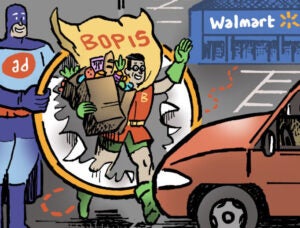
Walmart turned heads with last week’s acquisition of TV ad platform Vibe.co. But the acquisition was part of a years-long coming together of retailers and video streaming platforms.
Sometimes there’s a consumer angle (i.e., Amazon Prime Video or Walmart’s packaging of Paramount+ with ads in its annual membership). But, generally, retailers are bulking up on lucrative video inventory for their retail media networks sourced via the likes of Roku, TikTok and YouTube.
In June, Walmart’s Vizio smart TVs (a business it acquired in 2024) began serving ads in partnership with Yahoo DSP, while Walmart Connect integrated with Google DV360 to target and attribute YouTube campaigns.
Kroger and Albertsons also offer YouTube integrations via DV360, and Kroger recently announced an audience-matching program for TikTok ads.

“Retail media is evolving beyond retailers’ owned-and-operated properties into a much broader media ecosystem,” Sean Crawford, managing director for North America at retail media consultancy SMG, tells Modern Retail.
Social video is part of people’s shopping journeys these days, says Christine Foster, group VP at Kroger Precision Marketing. It’s “where a lot of the meal inspiration gets planned, and a lot of health and beauty decisions get made,” she says. “And we need to be in those spaces.”
Arrr That’s A Tough One
Pirated live sports streams cost broadcasters and leagues tens of billions of dollars per year.
Subscribers can stream a legit TV broadcast to their laptop, then mirror and redistribute that stream to hundreds of thousands of other devices. Pirate streaming services like StreamSports99 take advantage with utter impunity.
Leagues and streamers know this happens but are powerless to prevent the piracy. Fixing the problem would likely take law enforcement working with leagues to quash illicit streaming at the infrastructure level.
Which is exactly what LaLiga, the top Spanish fútbol league, did in conjunction with authorities in Spain, Bloomberg reports. Now, during LaLiga games, whole swaths of Cloudflare-based sites – which is to say, the internet – are slowed or shut down in the country.
It’s a heavy-handed tactic, though. Health care services, government agencies and all sorts of important sites and apps use Cloudflare or could be disrupted by blunt IP blocking.
As a result, about 5.8% of the web’s most popular sites are blocked in Spain during LaLiga broadcasts, the Open Observatory of Network Interference tells Bloomberg.
That’s the kind of restriction on web activity you’d see in repressive political regimes, says OONI’s Maria Xynou. But seeing such a large portion of the web shut down to recoup lost revenue, she says, is “shocking.”
We Need External Validation
OpenAI is “clearly in the advertising business,” according to CRO Denise Dresser. But it needs to be in the measurement business, too.
OpenAI made a splash in Cannes last week by hyping its advertising ambitions and its ability to drive outcomes. Instead of proxies for performance, OpenAI favors good-old-fashioned purchase intent and claims that one in five queries on its platform carry clear commercial interest.
The problem is that, while ChatGPT Ads is developing on-platform measurement tools, it offers no outside validation … yet.
However, OpenAI asserts that adding third-party measurement will be a “natural evolution” for its infant ad platform, Digiday reports.
Without third-party verification, marketers aren’t so confident that they reached a human or that the ad didn’t appear in some way that might become a discreditable screenshot.
The transparency issue is additionally challenging given that OpenAI promises not to share user chats with advertisers. So placement-level reporting will be hard to come by. Such is the dilemma of trying to win both consumer and advertiser trust.
“That measurement gap is where campaign value disappears,” writes ad industry veteran Lou Paskalis in a column for AdExchanger. And OpenAI can’t afford to turn off advertisers as it prepares to go public.
But Wait! There’s More!
Walmart’s Vibe.co deal is a reminder not to spend too long courting Madison Avenue. [Digiday]
High click rates doesn’t mean that your ads are working anymore. [Search Engine Journal]
Here’s what it’s like inside an operation that pays users to make and clip undisclosed Kalshi ads. [Garbage Day]
YouTube commands more than 65% of Japan’s video-on-demand hours, particularly in news and baseball. [Deadline]
Hypothetically, if the Comcast-NBC split was an M&A play, who’d be interested in buying? [The Hollywood Reporter]
Starbucks employees were already going viral. Now Starbucks will pay them for it. [Entrepreneur]
You’re Hired!
Pinterest taps Snap’s Julie Henderson to lead communications. [Axios]
AdCellerant appoints Jonathan Kalstein to chief financial officer. [release]
Thanks for reading AdExchanger’s Daily News Roundup. Want it by email? Sign up here.