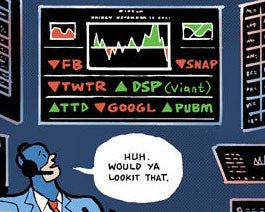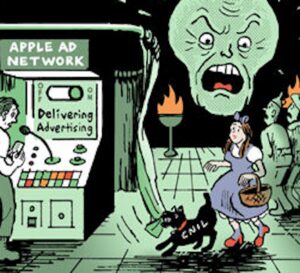

Connected TV measurement is so messy that I was invited to perform a stand-up comedy set about it earlier this week at the Cynopsis Measurement and Data conference in New York City.
Here’s what got the most laughs: making fun of the industry’s proclamations of collaboration amid ongoing bickering and data hoarding.
To dive deeper into what’s still missing from measurement and why, I also interviewed executives from LG Ads, FreeWheel and TelevisaUnivision on the Cynopsis stage.
After a full day of taking in measurement discussions, it’s become clear to me that data interoperability is still sorely lacking.

Don’t touch my data
Programmers and programming distributors are very protective of their first-party data because it gives them a competitive advantage. But advertisers keep clamoring for it, so publishers sometimes hedge on questions about how withholding data negatively impacts interoperability.
Not everyone has an LG TV, for example, but the company’s automatic content recognition (ACR) data is representative enough of the US population, says CMO Tony Marlow.
His assertion implies that advertisers don’t need to mix different ACR data sets to ensure the audience representation that is a must-have for effective measurement.
Plus, in terms of individual households, LG claims to have an almost exclusive audience. Most households with an LG TV likely don’t also have TV sets from other manufacturers, such as Samsung or Vizio.
But ACR sources might not be as representative as they claim to be. Total household counts get thrown around in a “cavalier fashion,” when, in reality, not every household counted in an ACR provider’s footprint actually has the software or Wi-Fi connection required in tracking, says Dan Aversano, SVP of data, analytics and advanced advertising at TelevisaUnivision.
The bottom line is that advertisers are still unable to compare reach and frequency across different publishers.
And ACR is just one of multiple types of first-party data clients aren’t getting enough of from media companies.
Enter clean rooms, a topic that came up many times throughout the Cynopsis conference.
Clean it up
The TV industry is zeroing in on clean rooms because their privacy-safe and mutually beneficial elements entice programmers and distributors into sharing data more openly.
For example, using clean rooms to increase match rates between brand and publisher data will boost return on ad spend for advertisers, which in turn raises inventory yield for programmers.
If only it were that simple.
Programmers, including NBCUniversal and Disney, are building and using their own clean rooms, which can ironically add to TV’s fragmentation problem because they don’t all measure ads across other programmers and therefore don’t answer the advertiser need for cross-publisher reach and frequency.
That’s why the joint industry committee (JIC) and some measurement providers are trying to build clean room technology that has no affiliation with inventory sellers. The goal is to make programmers more receptive to the idea of sharing their data in a way that protects both user privacy and competitive business information.
The JIC is being spearheaded by OpenAP, a data activation platform that’s powered by Snowflake, for example, and measurement company Tatari launched a sister company this week to house its new clean room.
Not to be left out, Nielsen announced on Wednesday that it, too, is developing clean room technology using Snowflake.
On its face, Nielsen’s clean room launch appears to address advertiser demands for data interoperability by embracing the need for industry collaboration – and, yet, Nielsen still refuses to join the JIC.
Oh, the irony.
Let me know what you think. Hit me up at alyssa@adexchanger.com.