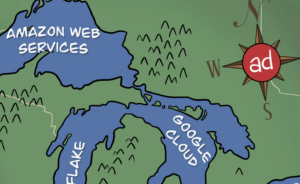
The ‘Online Advertising’ Category
Of many holy grails, the one involving effective cross-channel, digital media buying (let alone traditional channels) seems to remain elusive for the most part. Sure, you can capture a few search-ers who are showing intent for a blue Buick and then retarget them through display ad exchanges, but that's hardly the scalable motherlode for effective cross-channel media buying that many see on the horizon for advertising.
AdExchanger asked several executives from the media buying side of the ecosystem about how cross-channel is looking today beyond the significant challenge presented by the nexus of cookies and privacy. Specifically:
"What's your take on the hurdles of cross-digital audience buying today?"
Click below or scroll down for more:
- Jayne Pimentel, Head of Display Media, Razorfish London (Publicis)
- Sean Muzzy, Managing Director, N.A., Neo@Ogilvy (WPP Group)
- Chris Tuleya, Vice President, eDR, Underscore Marketing
- Philip Smolin, Vice President of Product, Platform Solutions, Turn
- John Grudnowski, Managing Partner, FRWD
- Seth Hittman, co-Founder & CEO, RUN
Jayne Pimentel, Head of Display Media, Razorfish London (Publicis)
"Advancements in Display Advertising technologies – specifically those related to data collection, management and analysis - have allowed smarter cross-digital audience buying to evolve. However, as with most advancements in the space that sound fantastic in theory we are seeing some challenges in practice. Three main hurdles facing any cross-digital audience buyer today are data management, device fragmentation and privacy.
- Collecting, analysing and synthesizing the vast amounts of data required for integrated cross-digital buying is no small feat and would surely be impossible without a good way to handle those processes. DMPs have emerged to help ingest, clean up and process this data to make it usable for RTB, but there is still more work to be done.
- Truly cross-digital retargeting is currently not fully realised due to device fragmentation and trying to make the connection between browser cookies, UIDs, CRMs, smart TVs, etc. We’ve seen a growing trend towards device fingerprinting and other methods to help connect all of those dots, but privacy and accuracy concerns still exist.
- The Eurozone is in a period of uncertainty with respect to the new EU Cookie Directive and what its implications may be from a privacy (targeting) perspective. The outcome could certainly have a major effect on the data available for audience buying across the digital landscape. While we of course believe that the relevancy and value of messaging can be increased while maintaining an individual’s privacy, this is currently a serious threat.
Technical and political hurdles notwithstanding, there is an ever-increasing amount of very rich data out there and a number of constantly improving solutions to help manage and make sense of it all. As a result we are now able to make more intelligent cross-digital buys than ever before that improve the results for our clients. Looking forward to what’s next!"
Read the rest of this entry »
Posted in Online Advertising | No Comments »
Yuchun Lee is svp and general manager,
Enterprise Marketing Management Group, IBM. Lee co-founded Unica which was acquired by IBM in 2010.
Lee discussed industry trends and his company's positioning - especially as it relates the CMO.
Click below or scroll for more:
AdExchanger.com: Thinking back to the beginnings of Unica, was there any seed that you can point to, that speaks to the strategy of the Unica unit within IBM today?
YUCHUN LEE: There's a parallel between the start of our trajectory in the marketing space and IBM's, in that we all came from the angle of analytics. Unica was founded on data mining technologies. In the early days of the company, we were tackling problems beyond marketing, including those in manufacturing process control, financial engineering, derivative trading and so forth.
But, very soon we realized that analytics and the ability to data mine and predict customer behavior is a huge competitive advantage for businesses. We thought that as a small company, we would focus on the area of analytics for marketing. If you think about IBM's initiative around “Smarter commerce,” it’s centered on the customer's data and the ability to analyze, leverage and optimize businesses around that data. It's the same footprint. Obviously we've used the CMO's role in this future of customer-centricity as so important that IBM has put emphasis on making sure we can offer an end‑to‑end solution to the chief marketing officer.
Read the rest of this entry »
Posted in Online Advertising | No Comments »
Dan Salmon is an equity research analyst at BMO Capital Markets and covers advertising and marketing services. With earnings season beginning to wane, Salmon shared a few thoughts with AdExchanger on the latest machinations in the data-driven ecosystem including today's announcement regarding Aol selling remnant display inventory through Yahoo!'s Right Media Exchange.
AdExchanger.com: You suggested in your comments to investors recently that Yahoo! CEO Scott Thompson could be a good fit for unlocking the value of Right Media Exchange in that he's a product guy. Why?
DAN SALMON: Many investors and industry executives have been skeptical of Thompson's hiring due to his lack of background in advertising and media. While that is understandable, I'd argue that as technology is tied more closely to advertising via IP communications networks, Thompson's background actually brings complementary expertise to Yahoo's "ad people" like Ross Levinsohn and Wayne Powers. As exchange-based, real-time bidding becomes increasingly prevalent – not just in display, but also mobile and online video, and eventually, DOOH and IPTV – Yahoo! should be well served by a leader that understands the nature of product development and someone who speaks the language of the engineering community. Content deals and the hiring of strong salespeople is a constantly fluid element of Yahoo!'s business, but the technology must be a consistent foundation.
When you look at Aol, what are some of the key things you're looking at regarding the success of its display advertising strategy?
Read the rest of this entry »
Posted in Online Advertising | 1 Comment »
AOL's Q4 looked much like the previous three quarters: double digit growth in display, both domestic and international, as well as a further slowing of its revenue declines. Not to mention, the low expectations of Wall St. analysts also helped it top consensus targets. Read the earnings release.
But other problems are still more acute, such as the 18 percent decline in its subscription business -- the area that represents AOL's legacy and it's principle money-making operation. The big question for AOL has long been: does it have time to build a stronger display business that will eclipse the losses from dial-up subscriptions?
Given the competition, AOL is more pressed than ever, even as it sees total display gains of 15 percent. As eMarketer notes in a comparison, Yahoo's share of the display market this year is expected to be 12.5 percent, followed closely by Google at 12.3 percent -- and the search giant is quickly gaining from last year's 9.3 percent share of the market, while Yahoo is losing ground from 2011's 13.1 percent share. Still, the display dollars are shifting away from the portals, as Facebook is the leader, with an expected 19.5 percent share this year, up from 16 percent in 2011.
That leaves MSN and AOL to fight it out for the shrinking scraps: eMarketer projects AOL's display share to go from 4.2 percent in 2011 to 3.9 percent in 2012. Microsoft will dip to 4.8 percent this year from 4.9 percent in 2011.
Still, AOL believes that its larger, more engaging premium ad units from its Project Devil will defy those predictions of decline, at least somewhat. AOL didn't have many details in its Q4 release, but it did say generally that the brand campaign under Devil saw advertisers, impressions and revenue grow at double-digit rates. Hopefully, there will be a little more color on Devil during the earnings call later this morning.
In the meantime, here's some topline figures from the release:
-- Global advertising revenue was up 10 percent, its third consecutive quarter of year-over-year growth.
-- 20 percent growth in third party network revenue. AOL also said it had the lowest rate of search and contextual revenue decline in approximately 3 years, due in large part to growth in search revenue on AOL.com.
-- Traffic: Consumer usage was flat to Q3 2011 as growth in the Huffington Post Media Group sites offset declines at MapQuest and AIM.
-- Net income was down 66 percent, though here too, the declines were showing signs of narrowing.
By David Kaplan
Posted in Online Advertising | No Comments »
Alan Yan is CEO of AdChina, an online advertising platform company in China.
Yan discussed his company and the Chinese online advertising market with AdExchanger.
AdExchanger.com: What are some of the challenges with the Chinese market when it comes to online advertising?
AY: There are several major challenges.
First, the pricing model - the majority is still CPD or cost per day. People also call it CPT, cost per time. Basically, you buy ad impressions on a time basis so it's similar to the sponsorship pricing model you find in the US. Though CPM is often used for brand advertising elsewhere, it is still not in the mainstream here.
When we started our business back in 2007, [media on a CPM basis] was rarely sold. Today, it's about probably 15 to 20 percent of the entire brand advertising spend in the Chinese market. So there's a lot, but it is small compared to CPT. That's one challenge.
Also, because of CPT, you basically don't have any room to optimize your campaign’s performance. You just place the ad and then wait until the end. So we believe that CPT, or CPD now, the time‑based pricing model is not the right thing, obviously. I personally believe in brand advertising’s CPM model. For performance, CPA.
Why did the CPT and CPD models make sense originally?
If you think about the Chinese advertising industry, the whole advertising sector just started back in the late `80s. And when the Internet and its advertising opportunity emerged in the late `90s, the first online advertising campaigns happened in China. Not many people had the expertise in advertising and advertisers here tended to only want to see their ads - that’s what made them feel comfortable.
Read the rest of this entry »
Posted in Online Advertising | No Comments »
For marketers, the ease of using a single buying metric - The Gross Rating Point (GRP) - across traditional and digital channels remains attractive, but whether it can be effectively extended to digital remains to be seen as this survey of industry executives indicated last year on AdExchanger.
Last week, comScore stirred the GRP pot and introduced its solution to unlocking digital for marketers and calling it the "vGRP." Read the interview with comScore exec Kirby Winfield here.
AdExchanger reached out to Scott McKinley, EVP of Advertising Effectiveness at Nielsen, to understand how his company approaches the GRP and differentiates.
AdExchanger.com: Can you discuss at a high-level your ideas - and Nielsen’s - on the GRP and the need for it?
Scott McKinley: The problem of measurement for digital is an old problem. It started shortly after the Internet achieved commercial scale in the mid 90's, and it has persisted until today. In fact, in November, I was at two different CMO conferences and can say that the CMOs of November 2011 aren't that much different in terms of their sophistication around an understanding of how to use digital in their mix than the CMOs of 1998. It's such a big problem and it's been attacked from so many different directions. And, the industry has not been successful at coming up with a solution to offer a true understanding of how to measure digital in the context of all the media opportunities that an advertiser has.
And that has been part of the problem, too - as digital has gotten more and more sophisticated and “sharpened” its set of tools for measurement, it's done it myopically, and in a way that's alienated the brand advertiser, which is of course the opposite of what was intended.
As a result, you get these digital advertising systems that are so complex and interwoven with each other and they're all answering questions that have nothing to do with brand advertising.
They're answering measurement questions that have to do with direct response. That's the irony: the smarter online gets about direct response, all they're doing is improving a language that the brand advertiser doesn't speak.
We as an industry, as a research industry, and from the medium's perspective as well, we've got to get digital to speak brand. For years, it was digital trying to teach brand advertisers how to speak its language, and the brand advertiser basically rejected it. To a brand advertiser - to Tide or Pampers or Clorox, or any of these brands - a click really doesn't mean anything. What means something is changing attitudes and reaching audiences.
Read the rest of this entry »
Posted in Online Advertising | 1 Comment »
Last week, Vibrant Media announced the acquisition of in-image ad network Image Space Media (ISM). From the release: "The acquisition of ISM will enhance the delivery of Vibrant Image, a product that identifies static images within brand-safe content across the Web and embeds small overlays within them at the bottom of the image." Read the release. Terms were not disclosed.
Vibrant Media CEO Cella Irvine discussed the acquisition and some of its implications.
AdExchanger.com: In that you have Vibrant Image already, is the acquisition of ISM more about publishers or technology?
CELLA IRVINE: Both, really.
Think about this: There are billions of quality images on the Web and approximately 25%-30% of website “real estate” is made up of images. Until now, this content has been unmonetizable for publishers – and for some publishers this unmonetized image content makes up a good portion of page views. We see that every page viewed on Vibrant’s network has, on average, 1.5 images. This is a tremendous opportunity for publishers to add value to their content in an innovative, user-initiated, and effective way.
Of course, this deal also gives a boost to our technology. We looked at this space rigorously and saw that Image Space Media’s technology platform and skills were best-in-market. We can now bring together their technology with our contextual data and algorithms to provide brands with innovative and effective ways to reach consumers, publishers with ways to monetize valuable assets, and users with ways to interact with a relevant ad where and when they choose.
Read the rest of this entry »
Posted in Online Advertising | No Comments »
Duncan McCall is CEO & Co-Founder of PlaceIQ, a location-based data advertising technology company.
McCall discussed the latest regarding location-based advertising and his company, which announced a new round of funding in December.
Click below or scroll down for more:
AdExchanger.com: Have location‑based services and targeting moved beyond a mobile advertising requirement or format? - I believe that's a goal you were talking about when we spoke last April.
DM: I'd spin that around and answer your question by saying what we've learned since we last talked is that our aspiration now is to be an audience company. And, we're already doing that. We're finding audience.
We’re extending that out from mobile into online, out‑of‑home and digital out‑of‑home. It begins with this concept that mobile is location‑aware and impressions often come with location on them. But, location is prevalent throughout many digital and analog advertising elements, whether it’s a billboard you're walking past or a digital billboard - be it TV, online, mobile or other elements. And, there's no real cross‑platform way to understand, segment and target audience across these different mediums.
If you're an agency, you have out‑of‑home, mobile and digital spend – plus, at least, three others. Then, you quantify an audience across these mediums. You know you’re hitting the same audience at home on TV, then out‑of‑home when they're commuting past a billboard. Maybe they get to work and you’re targeting them there as well - as in a privacy‑friendly, scalable fashion. The big goal we're working towards here is this concept of location because we all live in a physical world and so many of the digital elements we connect through are location‑aware now - and increasingly so as IPTV becomes more prevalent.
The big opportunity in location-based services is much broader than mobile. Mobile's a beautiful starting point, and there's heavy differentiation there, but there's a much bigger application of this throughout digital and offline mediums.
When people hear of "location‑aware advertising," they immediately think GPS, zip codes or IP addresses. What degree of location granularity do the users come with?
Read the rest of this entry »
Posted in Online Advertising | 1 Comment »
It's earnings season!
Today, Google was among the first of the big Internet companies to report calendar Q4 2011. It's interesting to note that Microsoft and IBM decided to report today, too. Conspiracy?!?! Perhaps against Wall Street analysts - a busy day for them.
Google CEO Larry Page remarked in the earnings release that the company broke the $10 billion barrier - with traffic acquisition costs (TAC) - for the first time ever as the seasonal bump around the holidays and shopping ad spend helped push revenues higher. Foreign exchange affected the company negatively to the tune of $200 million. Additionally, the CFO Patrick Pichette said that adjustments to fine tune the search algo also hit revenue... this nugget proved to be rich fodder for analysts later on the call who nevertheless struggled to understand.
$8.13 billion in ex-TAC revenue worked out to $9.50 earnings per share. Wall Street analyst Citi's Mark Mahaney had expected "$8.30B in Net Revenue and $10.52 in Non-GAAP EPS." ...So not quite as good as The Street expected. Read the release including Google+ traction - the company claims 90 million Google+ users. More signal feeding the beast!
On The DoubleClick Ad Exchange front, the company said on the call that revenue was up 130% year over year but no one was breaking out exactly what that means. I would assume that's total transaction revenue through the exchange - where the margins and revenues (ex-TAC) lie may be small at this stage considering Google is in investment mode and it wants to encourage use of its ad tools and exchange, in particular. Also, the company reported that the number of advertisers using the DoubleClick Exchange have more than doubled year-over-year. I'd also assume that number is real, live advertisers rather than more DSP and ad network partners. Transparency into who's buying and selling has been a Google mantra.
Read the rest of this entry »
Posted in Online Advertising | No Comments »
Yesterday, comScore announced its Validated Campaign Essentials (vCE) product which marks the next evolution in integrating AdXpose into its product line devoted to ad effectiveness. AdXpose was acquired back in August for $22 million (AdExchanger Q&A).
The release states that vCE provides a "view of campaign delivery and a verified assessment of ad-exposed audiences via a single, third-party source." Furthermore, according to the company, the new product looks at "a variety of dimensions, such as ads delivered in-view, in the right geography, in a brand safe environment and absent of fraudulent delivery." Read the release.
Kirby Winfield, SVP, Corporate Development at comScore and former CEO of AdXpose, answered questions regarding the announcement.
So, is [yesterday]'s announcement essentially the next gen of AdXpose within comScore's product offering?
It’s quite a bit more than just another version of AdXpose. It’s really what we envisioned when we decided to sell the company to comScore: a one-tag, soup to nuts solution for measuring and validating each impression in an online ad campaign, from the legacy “ad verification 1.0” metrics to the next generation comScore audience and reach/frequency metrics. This collaboration inspired our combined tech and research science teams to come up with the Validated GRP (vGRP), which finally tackles the huge problem of inaccurate reach and audience measurement head-on.
What is a vGRP?
Read the rest of this entry »
Posted in Online Advertising | 1 Comment »