
Wall Street Turned Against Ad Tech – But May Learn To Love It Again
What can pureplay ad tech companies do to clean up their rep on the Street?

What can pureplay ad tech companies do to clean up their rep on the Street?

Amid the political and economic uncertainty in the United States, ad spend will likely grow, but at a much slower pace, over the next five years.

Forrester is ranking vendors for the breadth of their capabilities over those with point solutions. And the “jacks of all trades” are in the lead.

The online advertising industry is staring down the barrel of not one but two potential shutdowns that could radically change where brands put their ad dollars in 2025, according to Madison and Wall’s Brian Weiser and Olivia Morley.

Originally, Ad-Shield Co-Founder and CEO Joon Yu intended to build software to block ads. Now, the business is focused on ad block recovery.

The ad market is “healthy and maybe unsustainably strong” this year, according to the latest report from Madison and Wall’s Brian Wieser.

Netflix plans to introduce ads … and ad tech vet (and mayor of ad tech Twitter) Ari Paparo is rolling out an SVOD service of sorts. Weird world. On Monday, Paparo, who sold his last company, Beeswax, to Comcast in early 2020, launched Marketecture.tv, a startup to help prospective technology buyers understand and evaluate the technology they buy before they buy it.

Even if digital video continues to grow through the COVID-19 crisis, growth rates will decline dramatically in the first half of 2020 from previous estimates, according to an eMarketer forecast released Friday. Digital video ad spend in the United States could potentially grow 7.8% during the first half of 2020 to $17 billion or, on […]

Ad spend by major brands in China has dwindled significantly in the wake of the COVID-19 pandemic, and could be a sign of what’s to come across the rest of the world. EMarketer slashed its October China ad spend forecast by 6.2% on Tuesday, bringing annual media spend projections down from 10.5% growth to […]

Digital is still growing faster than any other advertising medium in the United States, but the segment is starting to show signs of maturing. US digital advertising revenues grew 17% YoY in the first half of 2019, reaching $58 billion, according to the IAB’s internet advertising revenue report, released Monday. While that’s the highest first-half […]

Google is still by far the dominant player in search advertising, but Amazon is quickly stealing share as it grows in the number two spot. Amazon’s search business will grow 30% in 2019 to $7 billion, making up 13% of the total US search market, according to a forecast released Tuesday by eMarketer. That’s peanuts […]

The ad tech tax is decreasing as vendors along the supply chain become more transparent and lower their fees. While total US dollars spent on fees for non-social programmatic buys will grow 18% to $11.6 billion in 2019, that number is rising in aggregate because the amount of money spent on programmatic is increasing overall, […]

Dynamic creative advertising technology is becoming more personalized. Forrester ranked Jivox, RevJet, Thunder, Clinch and Celtra as “leaders” in its first-ever Creative Advertising Technology wave, released Monday. Adform, Flashtalking, Sizmek and Google were ranked “strong performers,” while Adacado was listed as a “contender.” Vendors have tried to marry creative messaging to audience targeting for a […]

The in-housing trend prompted Gartner’s first-ever Magic Quadrant report for ad tech, which was released late last week. Even if not all marketers are ready or interested in taking their media buying in-house, there’s a desire across the board for more control over their tech stack – or at least to know what the heck’s […]

From AT&T buying Time Warner to Disney’s purchase of 21st Century Fox, there’s been no shortage of media mega-mergers in the market. But those macro-deals overshadow smaller mergers and bolt-on acquisitions that made up the bulk of activity in the media and telecom sector for the first half of 2018, said Bart Spiegel, US media […]

On Monday, Pivotal analyst Brian Wieser informed investors he will begin covering Criteo and The Trade Desk as his first ad tech stocks. Wieser covers large entities across the media and marketing sectors. His smallest previously was Interpublic Group, which has a $10 billion market cap. But when investors began asking him more about ad […]

Advertising and marketing companies were leading acquirers in the media and telecom industries this quarter, according to PricewaterhouseCooper’s US Media and Telecommunications Deal Insights study released Thursday. Advertising and marketing firms led deal volumes for the quarter, representing 33% of the overall M&A activity in the media and telecom sectors. Deal volumes in marketing and […]

Forrester’s latest evaluation of standalone data management platforms (DMPs), released Thursday, arrives one week after its assessment of demand-side platforms (DSPs). While DMPs originated as audience segmentation tools to enhance media buying, the value prop of a standalone DMP is very different from one tied to a DSP, said Forrester’s senior analyst Susan Bidel. Forrester reviewed […]

Digital agencies aren’t shrugging off management consultancies as competition anymore. Some are even promoting their consulting chops as they compete in an increasingly crowded market. “Until this year, traditional agencies had their heads in the sand about the threat management consultancies were bringing to the market,” said Jay Wilson, director at Gartner and author of […]

Andrew Bruckner, VP of equity research at RBC Capital Markets, will share the Wall Street POV on programmatic at Programmatic IO on April 5 in San Francisco. There’s room in the digital advertising ecosystem for more than just the duopoly. “I do see an opportunity outside of Facebook and Google,” said Andrew Bruckner, VP of […]

By 2017, digital advertising spend will catch up with linear TV at $68 billion, according to Magna’s latest update to its US ad revenue forecast. But linear TV isn’t going anywhere just yet. “This year what has surprised me is the resilience of national TV,” said Vincent Letang, EVP for global market intelligence at Magna. […]
Marketing services and tech M&A activity in the first quarter of 2016 resulted in 187 transactions that generated $8.1 billion of deal value, according to JEGI’s Q1 2016 M&A overview report, released on Friday. More than half of the deal value in marketing services and tech came from the data and analytics subsector ($4.3 billion […]

Affinity Answers, founded under the name Colligent in 2005, has spent a decade building a new metric for brand success. The data measurement company processes the social information of more than 400 million users per day to identify mutual affinities between brands and publishers that help them uncover, target and monetize untapped audiences. The company […]

Viewability and fraud will be addressed at AdExchanger’s upcoming CleanAds I/O conference on June 3, along with a host of other inventory quality and supply chain issues in the digital advertising ecosystem. Screening out fraudulent and non-viewable ads has never been easier or more popular. Last summer AdExchanger reported that the number of marketers running viewability […]

Accenture is banking that the future of digital media and marketing depends on how organizations embrace change management. In December, the consultancy consolidated its digital divisions into Accenture Digital, an arm that includes its CMO advisory Accenture Interactive and mobility and analytics services. This move followed the acquisitions of design and creative agency Fjord and […]
This is the third in a series on what’s broken in the analytics space. Part one addressed data ownership, part two focused on technology and this story is about people and processes. Part two of this series looked at startups that are trying to unify disparate marketing metrics, but technology can only go so far in solving […]
This is the second in a series on what’s still broken in the analytics space. Part one dealt with data ownership, part two will address technology and part three will focus on people and processes. Even when data ownership issues are resolved between marketers and third-party agencies and service providers, the way in which it is […]
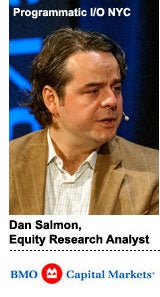
Dan Salmon is an equity research analyst at BMO Capital Markets and covers media and Internet marketing. He recently released a new research report on Social TV and its impact on advertising and marketing. You can download it here (PDF – 7 MB). AdExchanger recently discussed the new report with Salmon and asked his thoughts […]

If I were to pick one person who could distill for today’s marketer the rapidly innovating, marketing technology ecosystem, the selection would be simple enough. Who knew I’d someday have the good fortune to work with that person, too? I am excited to announce that Joanna O’Connell has joined AdExchanger as our Director of Research. […]

For advertisers, the stakes for capturing and leveraging data are higher than ever, placing analytics firms high in demand. Few web and mobile analytics firms have been around as long as Webtrends, which is about to celebrate its twentieth birthday. AdExchanger sat down with CEO Alex Yoder to talk about the Portland, Ore.-based company’s growth, […]