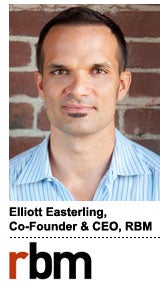
 RBM Co-founder and CEO Elliott Easterling is a believer.
For his San Francisco-based performance marketing agency, which has broadened its scope beyond search to display as well as other channels, agile marketing works – and the $6 million in net revenue last year is the proof.
Ignited by Silicon Valley startups and its agile product development movement, agile’s approach to marketing claims to be opportunistic and brings unique, iterative development to the client’s plan – and even the agency itself. Easterling says, “With the fragmentation occurring in the marketplace today, the data that’s available, a changing market landscape with lots of new channels coming up, it’s impossible to put a yearly marketing plan in place. You need to be constantly pivoting your business.”
Don’t mistake RBM (a.k.a. Red Bricks Media) for strictly a bottom-of-the-funnel direct response agency, though. Performance should include a brand “experience” management according to Easterling, who adds, “We optimize an overall experience in terms of determining the right channel mix with content as the fuel.”
Meanwhile, on the client side, data-driven digital is bringing new requirements to clients’ staffing, technology and media mix modeling needs. Regarding technology, Easterling notes, “We call ourselves systems integrators. We’re integrating sophisticated marketing technologies into our clients’ businesses.”

AdExchanger spoke to Easterling recently.
AdExchanger: In that you’re getting into the content marketing world, how does that play out internally for your agency? Do you need more storytellers?
ELLIOT EASTERLING: We’ve bringing on more brand marketers, storytellers lately. What we want to have our storytellers do is focus on the data, and then the data will inform the storyline. We’re retooling storytellers to be data‑driven marketers, and I think that’s the future of content marketing.
How does your business breakout today in channel percentages?
A few years ago, we were 70% search, and now we’re probably 40% search, SEO and SEM. Another 30% is on the content marketing side, and then, with the rest, we’re building post‑click experiences.
For us, search and social are connected, too. We do a lot of social listening to really understand what are the themes and topics that people are passionate about which informs some of the content strategy around SEO and what we want to create.
It would seem that the search-social connection is counterintuitive – search is more bottom of the funnel, social works at the top of the purchase funnel. Why does it make sense to you?
It comes down to this idea of optimizing two algorithms. Facebook’s EdgeRank algorithm and then Google’s search algorithm. This means creating high‑quality content that people then want to connect with and evangelize. When they evangelize it, they share it socially. When they evangelize it, they link to it, and links are the core fuel of SEO.
Data fuels everything. Channels are all interacting. If you think of direct‑response as something that resides in a petri dish, independent of all the other variables, then you’re running on experiments. Consequently, I think that the data visualization field is going to be huge.
It seems like it has taken forever for data visualization to take off in advertising beyond Excel and simple graphs.
Part of the problem is that data sits in too many systems and no one has aggregated it in a meaningful way so that you can drive insight.
As tracking becomes more pervasive, there will be interesting hybrid products that are going to come out of that. At the end of the day, it’s not a perfect science. No one has a Google Analytics account that matches Omniture, ever. No one has their ad server match their GA account. It’s never going to be a perfect science, but I think it will become increasingly better.
What’s the opportunity that you see programmatic media holding for RBM?
Programmatic is the leading incubator for innovation around data‑driven marketing. Following the space and seeing what products come out can educate us about how we can do other forms of marketing.
But, we’ll see this become increasingly commoditized to a degree and we’re going to see rates come down. That’s why, from our perspective, looking at a bigger picture is more important.
A year or two from now, what are some milestones that you’d like to have accomplished at RBM beyond revenue goals?
One of the goals for us is to try and find a company about our size so we can double in size.
Also, I would like us to be the leading agency in the agile marketing space – something that I think will be on everyone’s lips by the end of the year.
Finally, I want us to be very successful in our data and analytics practice. If you can shepherd your client’s data, you have a McKinsey‑style relationship with customers. That is a very high‑value consulting relationship.
Follow Elliott Easterling (@e_easterling), RBM (@redbricksmedia) and AdExchanger.com (@adexchanger) on Twitter.